

Author – Kate Nonesuch
Each year Calgary Learns get asked to share resources about ways to build community & confidence in the classroom space, ways to create safe and welcoming spaces for learning. There is no guidebook for this but there are many wise practices. I often think of Kate’s quote:
“There is no better way to show respect to a learner than to listen. If you listen, learners will teach you how to teach them.”
I hope you enjoy Kate’s blogpost – Learners on the Teaching Team
Getting learners on the teaching team is my first order of business at the beginning of a new class. I like to put them on notice that my class is a little different, that I ask for unexpected things from students, that I expect them to participate in shaping the class.
Adult Basic Education students come with strong ideas about what school should look like, and they want me to stick to that program. When I ask them to do something unusual–an art project, for example, or the dreaded working in groups–they resist. They zone out, or grumble, or refuse to take part, and generally rain on my parade.
I have other ideas about what school could look like. I have activities, resources, learning strategies, games, and projects that I think will help them learn more easily, more thoroughly, and faster than lectures and worksheets. I can’t reach those goals unless the students engage with my methods of teaching.
I invite them onto the teaching team in the first week. I start by asking them I to tell me all the ways they have tried to learn whatever subject is on the table.
- What methods have past teachers used?
- What kinds of help did they get from friends and family?
- What activities helped?
- What was interesting?
- What did they hate?
- What did they have fun with?
Then I ask, “Does anyone know one single way to learn this subject that really works?” Invariably, nobody does because they have all been previously unsuccessful. This conversation makes the students partners in designing their own learning. The discussion about past methods of learning and teaching, an evaluation of what parts were more and less useful, and the conclusion that something new needs to be tried, means that they are helping to decide what form teaching will take.
Invite Students into the Decision-making Process
Before I introduce a teaching strategy that I think might meet with resistance, I present the strategy to the group and give my reasons for thinking it will be valuable. In math class, for example, I might want to ask them to use manipulatives to demonstrate that their answers to fractions problems are correct. (In English, I might want to establish a 10-minute free write at the beginning of every class.)
So I introduce the idea for their consideration, and start by explaining some of the advantages of this activity: what I know from past experience with classes; what research shows; that it saves time; that it makes the work easier to grasp; that it connects paper and pencil work to real life; that it’s fun; and other advantages as applicable. If I can get a student from a previous class to come in and talk it up, all the better.
I ask for their reactions, then propose that we try it out for a reasonable length of time, for example, three weeks, and that we evaluate it briefly at the end of the first week, and more thoroughly after the trial period. I make it clear that I will act on the decisions made at this final evaluation, and that I will stop using the strategy if most students don’t like it or don’t find it useful.
If the class agrees at this point to try the strategy, I explain it in a little more detail, with examples. I ask the class to predict what effects the new strategy might have. How might it increase understanding, improve memory, or lead to better test scores? How might it make class more enjoyable or interesting? All this discussion gives us something to watch for as we begin to use the strategy.
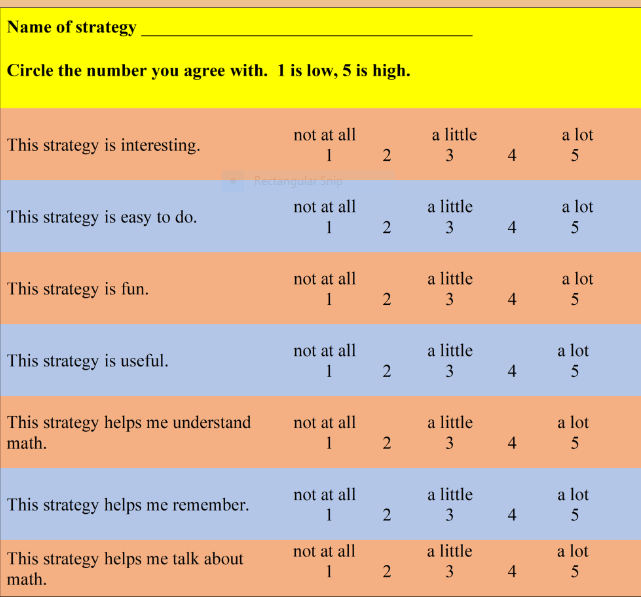
At the end of the first week, a brief discussion reminds people what we are looking for, allows students to give an initial response, and encourages everyone to keep with it for the rest of the trial period. Sometimes we get some insight into how to tweak the strategy slightly to suit the students’ needs.
At the end of the trial period, I do a more thorough evaluation. Sometimes I use an evaluation sheet like the one here, and sometimes I ask students to generate a list of questions they would like answered, and I turn that into an evaluation sheet. Collating and analyzing the answers is an interesting activity for the whole class, or for a small group of students.
I always keep my part of the bargain—that is, I abide by the evaluation of the class. Why would I try to force people to do something they believe is not useful?
First published on August 13, 2021
